Description
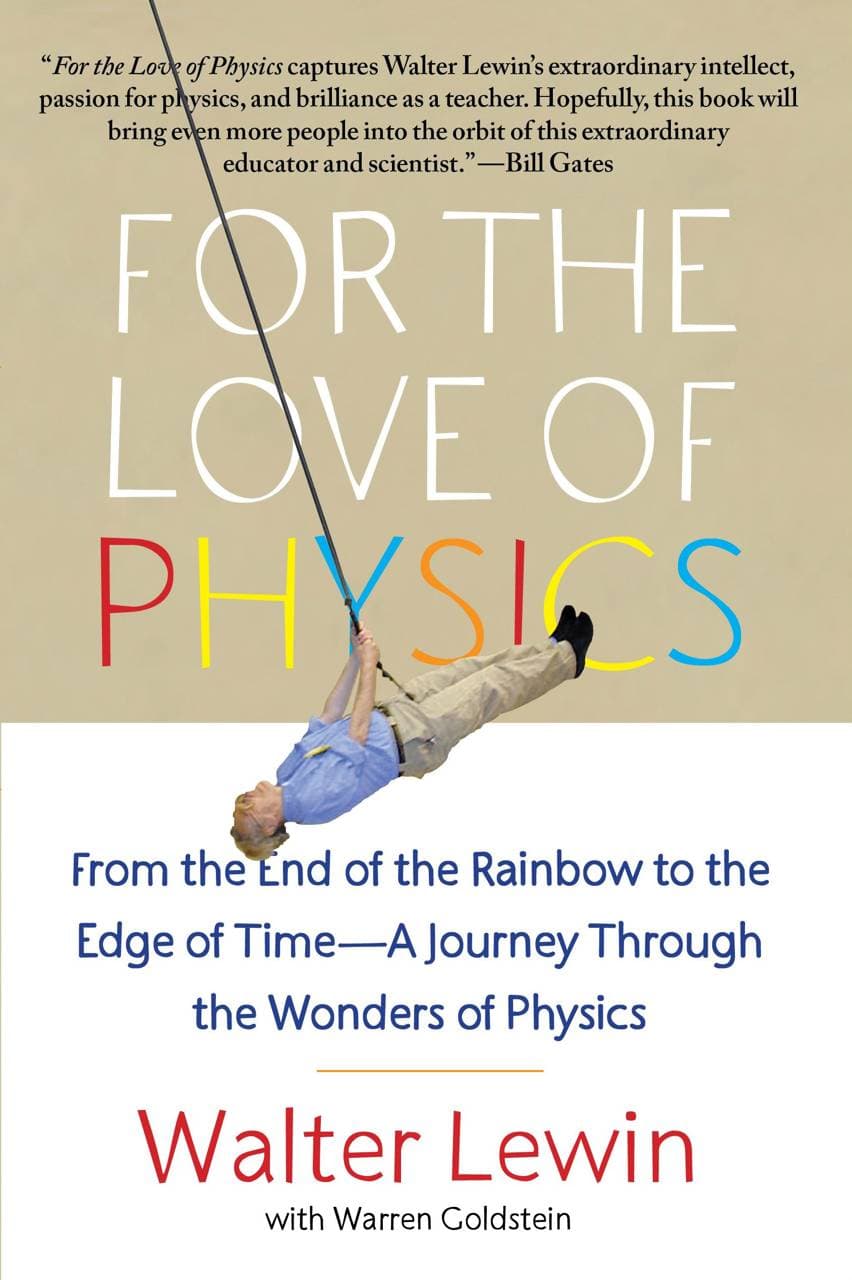
Beloved MIT professor Walter Lewin, whose riveting physics lectures have made him a YouTube super-star, offers a mind-opening and delightful journey through the most intriguing discoveries in physics. A wonderful raconteur, Lewin takes readers on a marvellous journey with him in For the Love of Physics, opening our eyes as never before to the amazing beauty and power of all that physics can reveal to us. He describes the coolest, weirdest facets of the tiniest bits of matter, the wonders of our everyday lives-such as the mysteries of why lighting strikes and what makes musical harmony happen-and the most awesome features of the outer reaches of the universe. Whether explaining why the air smells so fresh after a lightning storm or showing us that a flea is strong enough to pull a heavy book across a table, Lewin always entertains as he edifies. For the Love of Physicsis a rare gem that will change the way readers see the world.A largely autobiographical account of the author's life as one who fell in love first with physics and then with teaching physics to students.Biographical NoteWalter Lewin taught the three core classes in physics at MIT for more than thirty years and made major discoveries in the area of X-ray astronomy. His physics lectures have been the subject of great acclaim, including a 60 Minutes feature, stories in the New York Times, Washington Post, Boston Globe, Newsweek and US News and World Report. They have also been top draws on YouTube and iTunes University. He was awarded three prizes for excellence in undergraduate teaching. He has published more than 450 scientific articles, and his honors and awards include the NASA Award for Exceptional Scientific Achievement, the Alexander von Humboldt Award, and a Guggenheim Fellowship. He became a corresponding member of the Royal Netherlands Academy of Arts and Sciences and Fellow of the American Physical Society in 1993. He lives in Cambridge, Massachusetts.Warren Goldstein is a professor of history and chair of the History Department at the University of Hartford. A prizewinning historian, essayist, and journalist, he has had a lifelong fascination with physics. His writing has appeared in the New York Times, Washington Post, Boston Globe, Chicago Tribune and many other national periodicals. His prior books include Playing for Keeps: A History of Early Baseball and William Sloane Coffin, Jr.: A Holy Impatience.For the Love of Physics CHAPTER 1 From the Nucleus to Deep Space It’s amazing, really. My mother’s father was illiterate, a custodian. Two generations later I’m a full professor at MIT. I owe a lot to the Dutch educational system. I went to graduate school at the Delft University of Technology in the Netherlands, and killed three birds with one stone. Right from the start, I began teaching physics. To pay for school I had to take out a loan from the Dutch government, and if I taught full time, at least twenty hours a week, each year the government would forgive one-fifth of my loan. Another advantage of teaching was that I wouldn’t have to serve in the army. The military would have been the worst, an absolute disaster for me. I’m allergic to all forms of authority—it’s just in my personality—and I knew I would have ended up mouthing off and scrubbing floors. So I taught math and physics full time, twenty-two contact hours per week, at the Libanon Lyceum in Rotterdam, to sixteen-and seventeen-year-olds. I avoided the army, did not have to pay back my loan, and was getting my PhD, all at the same time. I also learned to teach. For me, teaching high school students, being able to change the minds of young people in a positive way, that was thrilling. I always tried to make classes interesting but also fun for the students, even though the school itself was quite strict. The classroom doors had transom windows at the top, and one of the headmasters would sometimes climb up on a chair and spy on teachers through the transom. Can you believe it? I wasn’t caught up in the school culture, and being in graduate school, I was boiling over with enthusiasm. My goal was to impart that enthusiasm to my students, to help them see the beauty of the world all around them in a new way, to change them so that they would see the world of physics as beautiful, and would understand that physics is everywhere, that it permeates our lives. What counts, I found, is not what you cover, but what you uncover. Covering subjects in a class can be a boring exercise, and students feel it. Uncovering the laws of physics and making them see through the equations, on the other hand, demonstrates the process of discovery, with all its newness and excitement, and students love being part of it. I got to do this also in a different way far outside the classroom. Every year the school sponsored a week-long vacation when a teacher would take the kids on a trip to a fairly remote and primitive campsite. My wife, Huibertha, and I did it once and loved it. We all cooked together and slept in tents. Then, since we were so far from city lights, we woke all the kids up in the middle of one night, gave them hot chocolate, and took them out to look at the stars. We identified constellations and planets and they got to see the Milky Way in its full glory. I wasn’t studying or even teaching astrophysics—in fact, I was designing experiments to detect some of the smallest particles in the universe—but I’d always been fascinated by astronomy. The truth is that just about every physicist who walks the Earth has a love for astronomy. Many physicists I know built their own telescopes when they were in high school. My longtime friend and MIT colleague George Clark ground and polished a 6-inch mirror for a telescope when he was in high school. Why do physicists love astronomy so much? For one thing, many advances in physics—theories of orbital motion, for instance—have resulted from astronomical questions, observations, and theories. But also, astronomy is physics, writ large across the night sky: eclipses, comets, shooting stars, globular clusters, neutron stars, gamma-ray bursts, jets, planetary nebulae, supernovae, clusters of galaxies, black holes. Just look up in the sky and ask yourself some obvious questions: Why is the sky blue, why are sunsets red, why are clouds white? Physics has the answers! The light of the Sun is composed of all the colors of the rainbow. But as it makes its way through the atmosphere it scatters in all directions off air molecules and very tiny dust particles (much smaller than a micron, which is 1/250,000 of an inch). This is called Rayleigh scattering. Blue light scatters the most of all colors, about five times more than red light. Thus when you look at the sky during the day in any direction*, blue dominates, which is why the sky is blue. If you look at the sky from the surface of the Moon (you may have seen pictures), the sky is not blue—it’s black, like our sky at night. Why? Because the Moon has no atmosphere. Why are sunsets red? For exactly the same reason that the sky is blue. When the Sun is at the horizon, its rays have to travel through more atmosphere, and the green, blue, and violet light get scattered the most—filtered out of the light, basically. By the time the light reaches our eyes—and the clouds above us—it’s made up largely of yellow, orange, and especially red. That’s why the sky sometimes almost appears to be on fire at sunset and sunrise. Why are clouds white? The water drops in clouds are much larger than the tiny particles that make our sky blue, and when light scatters off these much larger particles, all the colors in it scatter equally. This causes the light to stay white. But if a cloud is very thick with moisture, or if it is in the shadow of another cloud, then not much light will get through, and the cloud will turn dark. One of the demonstrations I love to do is to create a patch of “blue sky” in my classes. I turn all the lights off and aim a very bright spotlight of white light at the ceiling of the classroom near my blackboard. The spotlight is carefully shielded. Then I light a few cigarettes and hold them in the light beam. The smoke particles are small enough to produce Rayleigh scattering, and because blue light scatters the most, the students see blue smoke. I then carry this demonstration one step further. I inhale the smoke and keep it in my lungs for a minute or so—this is not always easy, but science occasionally requires sacrifices. I then let go and exhale the smoke into the light beam. The students now see white smoke—I have created a white cloud! The tiny smoke particles have grown in my lungs, as there is a lot of water vapor there. So now all the colors scatter equally, and the scattered light is white. The color change from blue light to white light is truly amazing! With this demonstration, I’m able to answer two questions at once: Why is the sky blue, and why are clouds white? Actually, there is also a third very interesting question, having to do with the polarization of light. I’ll get to this in chapter 5. Out in the country with my students I could show them the Andromeda galaxy, the only one you can see with the naked eye, around 2.5 million light-years away (15 million trillion miles), which is next door as far as astronomical distances go. It’s made up of about 200 billion stars. Imagine that—200 billion stars, and we could just make it out as a faint fuzzy patch. We also spotted lots of meteorites—most people call them shooting stars. If you were patient, you’d see one about every four or five minutes. In those days there were no satellites, but now you’d see a host of those as well. There are more than two thousand now orbiting Earth, and if you can hold your gaze for five minutes you’ll almost surely see one, especially within a few hours after sunset or before sunrise, when the S