Description
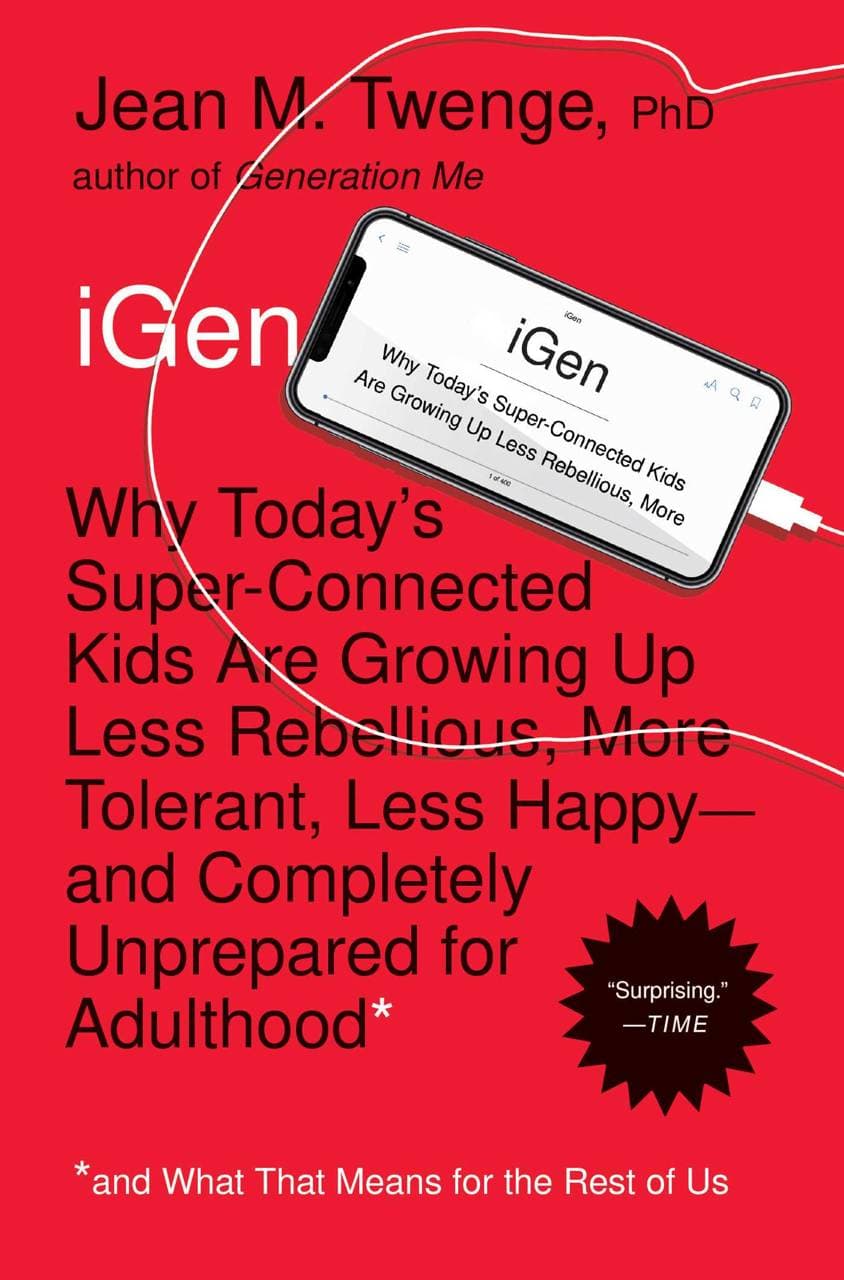
As seen in Time, USA TODAY, The Atlantic, The Wall Street Journal, and on CBS This Morning, BBC, PBS, CNN, and NPR, iGen is crucial reading to understand how the children, teens, and young adults born in the mid-1990s and later are vastly different from their Millennial predecessors, and from any other generation.With generational divides wider than ever, parents, educators, and employers have an urgent need to understand today’s rising generation of teens and young adults. Born in the mid-1990s up to the mid-2000s, iGen is the first generation to spend their entire adolescence in the age of the smartphone. With social media and texting replacing other activities, iGen spends less time with their friends in person—perhaps contributing to their unprecedented levels of anxiety, depression, and loneliness. But technology is not the only thing that makes iGen distinct from every generation before them; they are also different in how they spend their time, how they behave, and in their attitudes toward religion, sexuality, and politics. They socialize in completely new ways, reject once sacred social taboos, and want different things from their lives and careers. More than previous generations, they are obsessed with safety, focused on tolerance, and have no patience for inequality. With the first members of iGen just graduating from college, we all need to understand them: friends and family need to look out for them; businesses must figure out how to recruit them and sell to them; colleges and universities must know how to educate and guide them. And members of iGen also need to understand themselves as they communicate with their elders and explain their views to their older peers. Because where iGen goes, so goes our nation—and the world.Biographical NoteJean M. Twenge, PhD, a professor of psychology at San Diego State University, is the author of more than a hundred scientific publications and several books based on her research, including Generations, iGen, and Generation Me. Her research has been covered in Time, The Atlantic, Newsweek, The New York Times, USA TODAY, and The Washington Post. She has also been featured on Today, Good Morning America, Fox and Friends, CBS This Morning, and NPR. She lives in San Diego with her husband and three daughters.iGen Introduction Who Is iGen, and How Do We Know? When I reach 13-year-old Athena around noon on a summer day, she sounds as if she just woke up. We chat a little about her favorite songs and TV shows, and I ask her what she likes to do with her friends. “We go to the mall,” she says. “Do your parents drop you off?” I ask, remembering my own middle school days in the 1980s when I’d enjoy a few parent-free hours with my friends. “No—I go with my family,” she says. “We’ll go with my mom and brothers and walk a little behind them. I just have to tell my mom where we’re going. I have to check in every hour or every thirty minutes.” Hanging out at the mall with your mom around isn’t the only difference in teens’ social lives these days. Athena and her friends at her middle school in Houston, Texas, communicate using their phones more than they see each other in person. Their favorite medium is Snapchat, a smartphone app that allows users to send pictures that quickly disappear. They particularly like Snapchat’s “dog filter,” which inserts a cartoonish dog nose and ears on people’s heads as they snap photos. “It’s awesome—it’s the cutest filter ever,” she says. They make sure they keep up their Snapstreaks, which show how many days in a row they have Snapchatted with each other. Sometimes they screenshot particularly ridiculous pictures of friends so they can keep them—“it’s good blackmail.” Athena says she spent most of the summer hanging out by herself in her room with her phone. “I would rather be on my phone in my room watching Netflix than spending time with my family. That’s what I’ve been doing most of the summer. I’ve been on my phone more than I’ve been with actual people.” That’s just the way her generation is, she says. “We didn’t have a choice to know any life without iPads or iPhones. I think we like our phones more than we like actual people.” iGen has arrived. Born in 1995 and later, they grew up with cell phones, had an Instagram page before they started high school, and do not remember a time before the Internet. The oldest members of iGen were early adolescents when the iPhone was introduced in 2007 and high school students when the iPad entered the scene in 2010. The i in the names of these devices stands for Internet, and the Internet was commercialized in 1995. If this generation is going to be named after anything, the iPhone just might be it: according to a fall 2015 marketing survey, two out of three US teens owned an iPhone, about as complete a market saturation as possible for a product. “You have to have an iPhone,” said a 17-year-old interviewed in the social media exposé American Girls. “It’s like Apple has a monopoly on adolescence.” The complete dominance of the smartphone among teens has had ripple effects across every area of iGen’ers’ lives, from their social interactions to their mental health. They are the first generation for whom Internet access has been constantly available, right there in their hands. Even if their smartphone is a Samsung and their tablet is a Kindle, these young people are all iGen’ers. (And yes, even if they are lower income: teens from disadvantaged backgrounds now spend just as much time online as those with more resources—another effect of smartphones.) The average teen checks her phone more than eighty times a day. But technology is not the only change shaping this generation. The i in iGen represents the individualism its members take for granted, a broad trend that grounds their bedrock sense of equality as well as their rejection of traditional social rules. It also captures the income inequality that is creating a deep insecurity among iGen’ers, who worry about doing the right things to become financially successful, to become a “have” rather than a “have not.” Due to these influences and many others, iGen is distinct from every previous generation in how its members spend their time, how they behave, and their attitudes toward religion, sexuality, and politics. They socialize in completely new ways, reject once sacred social taboos, and want different things from their lives and careers. They are obsessed with safety and fearful of their economic futures, and they have no patience for inequality based on gender, race, or sexual orientation. They are at the forefront of the worst mental health crisis in decades, with rates of teen depression and suicide skyrocketing since 2011. Contrary to the prevalent idea that children are growing up faster than previous generations did, iGen’ers are growing up more slowly: 18-year-olds now act like 15-year-olds used to, and 13-year-olds like 10-year-olds. Teens are physically safer than ever, yet they are more mentally vulnerable. Drawing from four large, nationally representative surveys of 11 million Americans since the 1960s, I’ve identified ten important trends shaping iGen’ers and, ultimately, all of us: In No Hurry (the extension of childhood into adolescence), Internet (how much time they are really spending on their phones—and what that has replaced), In person no more (the decline in in-person social interaction), Insecure (the sharp rise in mental health issues), Irreligious (the decline in religion), Insulated but not intrinsic (the interest in safety and the decline in civic involvement), Income insecurity (new attitudes toward work), Indefinite (new attitudes toward sex, relationships, and children), Inclusive (acceptance, equality, and free speech debates), and Independent (their political views). iGen is the ideal place to look for trends that will shape our culture in the years to come, as its members are very young but still old enough to express their views and report on their experiences. I’ve been researching generational differences for nearly twenty-five years, starting when I was a 22-year-old PhD student in personality psychology at the University of Michigan. Back then I focused on how my own generation, Generation X, differed from Boomers (more gender equality and more anxiety, among other things). As time went on, I found a broad array of generational differences in behaviors, attitudes, and personality traits that distinguished the Millennials, the generation born in the 1980s and early 1990s. That research culminated in my 2006 book Generation Me, updated in 2014, a look at how the Millennials differed from their predecessors. Most of the generational differences that defined GenX and the Millennials came along gradually, building to a crescendo only after a decade or two of steady change. I had grown accustomed to line graphs of trends that looked like hills slowly growing into peaks, with cultural change making its mark after a measured rollout that started with a few young people and swelled to many. But around 2012, I started seeing large, abrupt shifts in teens’ behaviors and emotional states. All of a sudden, the line graphs looked like steep mountains—rapid drop-offs erased the gains of decades in just a few years; after years of gradual inclines or hollows, sheer cliffs suddenly brought traits to all-time highs. In all of my analyses of generational data—some of it reaching back to the 1930s—I had never seen anything like it. At first I wondered if these were random blips that would disappear after a year or two. But they didn’t—the trends kept going, creating sustained, and often unprecedented, trends. As I