Description
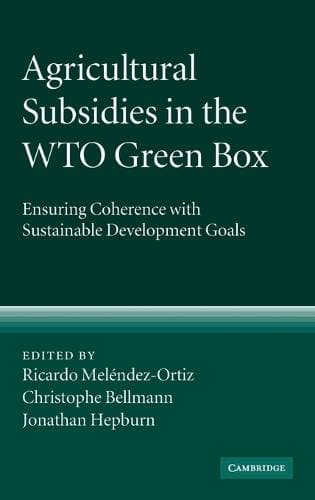
Do the World Trade Organization's rules on 'green box' farm subsidies allow both rich and poor countries to achieve important goals such as food security, or do they worsen poverty, distort trade and harm the environment? Current WTO requirements set no ceiling on the amount of green box subsidies that governments can provide, on the basis that these payments cause only minimal trade distortion. Governments are thus increasingly shifting their subsidy spending into this category, as they come under pressure to reduce subsidies that are more directly linked to production. However, growing evidence nonetheless suggests that green box payments can affect production and trade, harm farmers in developing countries and cause environmental damage. By bringing together new research and critical thinking, this book examines the relationship between green box subsidies and the achievement of sustainable development goals, and explores options for future reform.Table of Content1. Overview Christophe Bellmann and Jonathan Hepburn; Part I. The Recent Evolution of Agricultural Trade Policy Reform: 2. The historical context of the green box Néstor Stancanelli; 3. Doha Round negotiations on the green box, and beyond Jonathan Hepburn and Christophe Bellmann; 4. The reform of the EU's Common Agricultural Policy Alan Swinbank; 5. Farm policy reform in the US: past progress and future direction David Orden; 6. Agricultural trade policy reform in Japan Masayoshi Honma; Part II. The Focus, Extent and Economic Impact of Green Box Subsidies: 7. Agricultural support in the green box: an analysis of EU, US and Japanese green box spending Jesús Antón; 8. Green box subsidies and trade-distorting support: is there a cumulative impact? Carlos Galperín and Ivana Doporto Miguez; 9. The distributional structure of green box subsidies in the European Union and France Vincent Chatellier; 10. The distributional structure of US green box subsidies Harry de Gorter; Part III. Green Box Subsidies and Developing Countries: 11. Agricultural subsidies in the WTO green box: opportunities and challenges for developing countries André Nassar, Maria Elba Rodriguez-Alcalá and Cinthia C. Costa; 12. Use of green box measures by developing countries: an assessment Biswajit Dhar; 13. A Chinese perspective on the green box Jianmin Xie; 14. African countries and the green box Abena Oduro; Part IV. Green Box Subsidies and the Environment: 15. The environmental impact of green box subsidies: exploring the linkages Ron Steenblik and Charles Tsai; 16. The environmental impact of European Union green box subsidies Ariel Brunner and Harry Huyton; 17. The environmental impact of US green box subsidies Jane Earley; 18. Biofuels subsidies and the green box Tim Josling, Freeman Spogli and David Blandford; Part V. Looking Forward: How Can Change Take Place?: 19. Improving monitoring and surveillance of green box subsidies Andrea Cerda; 20. Subsidy reform in the EU context: options for achieving change Teresa Cavero; 21. Subsidy reform in the US context: deviating from decoupling Ann Tutwiler; 22. Subsidy reform in Japan: options for achieving change Kazuhito Yamashita; 23. Towards a green box subsidy regime that promotes sustainable development: strategies for achieving change Pedro de Camargo Neto and Renato Henz.Review Quote'This book constitutes a long-awaited and valuable contribution to clarifying what has become the core of agricultural negotiations: the fear that abusive migration toward so-called green-box subsidies might render meaningless any apparent progress in reduction of the more obvious distorting modalities. It is a well-balanced and thoughtful analysis of all relevant arguments in the debate and provides trade negotiators with an enlightened guidance to help the Doha Round deliver on its promise of putting world trade to the service of development needs and environmental improvement.' Ambassador Rubens Ricupero, former Secretary-General of the United Nations Conference on Trade and Development (UNCTAD)Review Quote'ICTSD has done the cause of agricultural trade reform a genuine service with its initiative to commission and edit this collection of papers on the impacts of existing Green Box subsidy expenditures and the case for changes in the WTO rules governing them. The book brings together thoughtful contributions from some of the best known experts in the field … [It] is a valuable compilation of analysis, comment and suggestions on the issues and deserves wide exposure.' Joanna Hewitt, former lead WTO negotiator and previous Head of Division in the OECD's Agriculture DirectorateReview Quote'This volume should prove invaluable for anyone seeking an encyclopedic and comprehensive coverage of current issues relating to green-box support. The sheer volume of material in this collection is staggering … I highly recommend the book to scholars of agricultural policy as well as to policy-makers interested in the intimate details associated with the WTO green box. The papers presented by this distinguished panel of experts provide an invaluable resource that previously did not exist in any single place.' The Journal of World Trade ReviewBiographical NoteRicardo Meléndez-Ortiz is co-founder and Chief Executive of the International Centre for Trade and Sustainable Development (ICTSD). His previous experience encompasses responsibility in a diverse range of capacities at the interface of international trade and sustainable development. Christophe Bellmann is the Programmes Director at the International Centre for Trade and Sustainable Development (ICTSD). Before joining ICTSD, Mr Bellmann worked with the United Nations Economic Commission for Latin America and the Caribbean (ECLAC), and with the Swiss Coalition of Development Organisations. Jonathan Hepburn is Programme Officer for Agriculture at the International Centre for Trade and Sustainable Development (ICTSD). Before joining ICTSD, he represented Oxfam International to the World Bank and IMF in Washington D.C., and led Oxfam's global campaign on aid, debt and the Millennium Development Goals. Previously, he worked on trade, development and human rights issues with the Quaker United Nations Office, Geneva.An analysis of the relationship between green box subsidies and sustainable development goals, which includes options for future reform.