Description
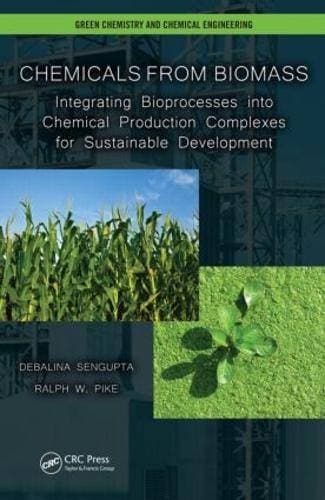
Chemicals from Biomass: Integrating Bioprocesses into Chemical Production Complexes for Sustainable Development helps engineers optimize the development of new chemical and polymer plants that use renewable resources to replace the output of goods and services from existing plants. It also discusses the conversion of those existing plants into facilities that are based on renewable resources that may require nonrenewable resource supplements.Relying on extensive reviews of biomass as feedstock and the production of chemicals from biomass, this book identifies and illustrates the design of new chemical processes (bioprocesses) that use renewable feedstock (biomass) as raw materials. The authors show how these new bioprocesses can be integrated into the existing plant in a chemical production complex to obtain the best combination of energy-efficient and environmentally acceptable facilities. This presented methodology is an essential component of sustainable development, and these steps are essential to achieving a sustainable chemical industry.The authors evaluate potential bioprocesses based on a conceptual design of biomass-based chemical production, and they use Aspen HYSYS® and Aspen ICARUS® to perform simulations and economic evaluations of these processes. The book outlines detailed process designs created for seven bioprocesses that use biomass and carbon dioxide as feedstock to produce a range of chemicals and monomers. These include fermentation, transesterification, anaerobic digestion, gasification, and algae oil production. These process designs, and associated simulation codes, can be downloaded for modification, as needed. The methodology presented in this book can be used to evaluate energy efficiency, cost, sustainability, and environmental acceptability of plants and new products. Based on the results of that analysis, the methodology can be applied to other chemical complexes for new bioprocesses, reduced emissions, and energy savings. Table of ContentIntroduction. Biomass as Feedstock. Chemicals from Biomass. Simulation for Bioprocesses. Bioprocesses Plant Model Formulation. Formulation and Optimization of the Superstructure. Case Studies Using Superstructure. Appendices.Review Quote"… this book’s detailed approach on a recent topic—biomass utilization—makes me interested and impressed as well. Especially, a plant simulation with optimization is a daunting task for any biochemical system. … the book deals with such a difficult task efficiently and in an easy way to make it acceptable."—Dr. Chiranjib Bhattacharjee, Department of Chemical Engineering, Jadavpur University, Calcutta, India"Overall, the book is well written and treats a timely subject with good breadth and depth, sufficient to make the material of practical use. Using biomass in existing chemical production complexes is important. The reason is that there is a great deal of chemical manufacturing infrastructure representing substantial capital that needs to be used gainfully. This makes the case studies very interesting."—Heriberto Cabezas, U.S. EPA, Office of Research and Development, Cincinnati, Ohio, USAReview Quote"… this book’s detailed approach on a recent topic—biomass utilization—makes me interested and impressed as well. Especially, a plant simulation with optimization is a daunting task for any biochemical system. … the book deals with such a difficult task efficiently and in an easy way to make it acceptable."—Dr. Chiranjib Bhattacharjee, Department of Chemical Engineering, Jadavpur University, Calcutta, India"Overall, the book is well written and treats a timely subject with good breadth and depth, sufficient to make the material of practical use. Using biomass in existing chemical production complexes is important. The reason is that there is a great deal of chemical manufacturing infrastructure representing substantial capital that needs to be used gainfully. This makes the case studies very interesting."—Heriberto Cabezas, U.S. EPA, Office of Research and Development, Cincinnati, Ohio, USABiographical NoteDebalina Sengupta received her bachelor of engineering degree in chemical engineering from Jadavpur University, Calcutta, India, in 2003. She worked as a software engineer in Patni Computer Systems from 2003 to 2004. In 2005, she joined the Department of Chemical Engineering at Louisiana State University, Baton Rouge, Louisiana. She received her doctor of philosophy degree in chemical engineering under the guidance of Professor Ralph W. Pike for her research titled "Integrating bioprocesses into industrial complexes for sustainable development" in 2010. Her expertise is in optimization of industrial complexes and sustainability analysis using total cost assessment methodology. She is now working as an ORISE postdoctoral fellow at the United States Environmental Protection Agency. Her current research is focused on sustainable supply chain design of biofuels and includes life cycle assessment (LCA) for ethanol as biofuel. Her research interests include chemicals from biomass, modeling, simulation, and optimization, as well as life cycle assessment and sustainability analysis.Ralph W. Pike is the director of the Minerals Processing Research Division and is the Paul M. Horton Professor of Chemical Engineering at Louisiana State University. He received his doctorate and bachelor’s degrees in chemical engineering from Georgia Institute of Technology. He is the author of a textbook entitled Optimization for Engineering Systems and coauthor of four other books on design and modeling of chemical processes. Pike has directed 15 doctoral dissertations and 16 master’s theses in chemical engineering. He is a registered professional engineer in Louisiana and Texas. His research has been sponsored by federal and state agencies and private organizations, with 107 awards totaling $5.6 million, and has resulted in over 200 publications and presentations. His research specialties are optimization theory and applications for the optimal design of engineering systems, online optimization of continuous processes, optimization of chemical production complexes, and related areas of resources management, sustainable development, continuous processes for carbon nanotubes, and chemicals from biomass.