Description
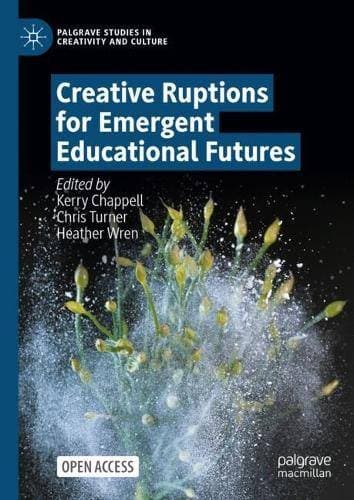
This open access book aims to show how creative ruptions – disturbances or commotions - can lead to the emergence of ethical, care-ful educational futures. Grounded in empirical and theoretical research undertaken from posthuman, decolonial, new materialist and feminist perspectives, this edited volume questions historical and current assumptions as to how education is structured and enacted, and provides examples and tools illustrating how to create and work with creative ruptions. Under the guidance of an experienced editorial team, the authors demonstrate how creative ruptions can respond to various wicked problems through the design and enactment of transformative pedagogies and accompanying research. Including consideration of how we can grow our emotional repertoires from anxiety to include hope and courage, the book explores how creativity might expand the horizons of personal, social and political possibility that take shape within – and ultimately determine – education and its futures.Offering theoretically driven and practically grounded transdisciplinary examples of alternative educational futures, this volume is an ideal reading for those interested in the intersecting fields of Possibilities Studies in Education, Creativity in Education, Educational Futures, Pedagogy, and related disciplines.Table of Content1.Creating Spaces for Ruptions and Provocations.- Part 1: Creating Spaces for Ruptions.- 2. Flowing with embodiment and materiality: touch and time for new educational futures.- 3. Exploring aeshoecology - affective anticipation, liminality and emergence as features of alternative educational futures.- 4. On bewilderment, education and opening spaces for creativity and emergent educational futures.- Part 2: Dialoguing.- 5. Journeying with affective embodied empathy for an ethical understanding of environmental education.- 6. (Ma)kin(g) sympoetic more-than-human educational futures.- 7. Sensing in liminal spaces: Words, music and dementia.- 8. Creativity in an emergent and improvisational global educational environment.- Part 3: Resistings.- 9. The aesthetics of African participatory music making through the eyes of Utu: An alternative approach to music education.- 10. Re-imagining research methods curriculum in education otherwise: A decolonial turn.- 11. Care as resistance within educational practice.- 12. Steps toward a decolonial feminist ecology.- 13. Conclusion: Inhabiting the cracks: Accumulating creative ruptions to change educationBiographical NoteKerry Chappell is an Associate Professor in the School of Education at the University of Exeter, UK, where she leads the Creativity and Emergent Educational futures Network and the MA Education Creative Arts Programme. She is also Adjunct Associate Professor at the Western Norway University of Applied Sciences. Her research focuses on creativity in education, specifically in the arts (dance) and transdisciplinary settings, and how creativity contributes ethically to educational futures. Chris Turner is an independent writer and researcher, and an Honorary Lecturer at the University of Exeter, UK. An expert in the field of education, his research and writing interests are in the aesthetics and ecology of education, from which he has developed the theoretical concepts of aesthoecology. A member of the Creativity and Emergent Educational futures Network at the University of Exeter, he has lectured widely on educational leadership and community education. Heather Wren is a Graduate Research Assistant and PhD student at the University of Exeter, UK. Her research explores environmental empathy using a New Materialist lens in an effort to understand how this type of empathy emerges in education. She is also a member of the Creativity and Emergent Educational futures Network at the University of Exeter.This open access book aims to show how creative ruptions – disturbances or commotions - can lead to the emergence of ethical, care-ful educational futures. Grounded in empirical and theoretical research undertaken from posthuman, decolonial, new materialist and feminist perspectives, this edited volume questions historical and current assumptions as to how education is structured and enacted, and provides examples and tools illustrating how to create and work with creative ruptions. Under the guidance of an experienced editorial team, the authors demonstrate how creative ruptions can respond to various wicked problems through the design and enactment of transformative pedagogies and accompanying research. Including consideration of how we can grow our emotional repertoires from anxiety to include hope and courage, the book explores how creativity might expand the horizons of personal, social and political possibility that take shape within – and ultimately determine – education and its futures.Offering theoretically driven and practically grounded transdisciplinary examples of alternative educational futures, this volume is an ideal reading for those interested in the intersecting fields of Possibilities Studies in Education, Creativity in Education, Educational Futures, Pedagogy, and related disciplines.Kerry Chappell is an Associate Professor in the School of Education at the University of Exeter, UK, where she leads the Creativity and Emergent Educational futures Network and the MA Education Creative Arts Programme. She is also Adjunct Associate Professor at the Western Norway University of Applied Sciences. Her research focuses on creativity in education, specifically in the arts (dance) and transdisciplinary settings, and how creativity contributes ethically to educational futures. Chris Turner is an independent writer and researcher, and an Honorary Lecturer at the University of Exeter, UK. An expert in the field of education, his research and writing interests are in the aesthetics and ecology of education, from which he has developed the theoretical concepts of aesthoecology. A member of the Creativity and Emergent Educational futures Network at the University of Exeter, he has lectured widely on educational leadership and community education. Heather Wren is a Graduate Research Assistant and PhD student at the University of Exeter, UK. Her research explores environmental empathy using a New Materialist lens in an effort to understand how this type of empathy emerges in education. She is also a member of the Creativity and Emergent Educational futures Network at the University of Exeter.Questions historical assumptions as to how education is structured and enacted Offers a range of creative approaches with emergent alternatives to traditional linear educational models Uses an intentionally diverse set of underpinnings to creatively counter injustice This book is open access, which means that you have free and unlimited accessOpen Access This book is licensed under the terms of the Creative Commons Attribution 4.0 International License (http://creativecommons.org/licenses/by/4.0/), which permits use, sharing, adaptation, distribution and reproduction in any medium or format, as long as you give appropriate credit to the original author(s) and the source, provide a link to the Creative Commons license and indicate if changes were made. The images or other third party material in this book are included in the book's Creative Commons license, unless indicated otherwise in a credit line to the material. If material is not included in the book's Creative Commons license and your intended use is not permitted by statutory regulation or exceeds the permitted use, you will need to obtain permission directly from the copyright holder.