Description
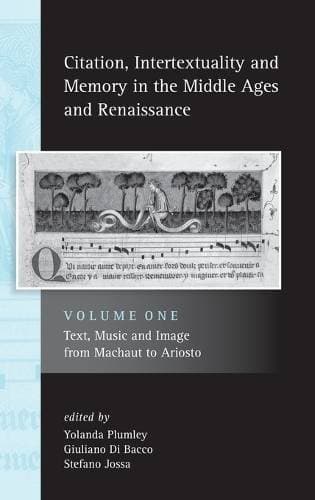
From the Middle Ages onwards, writers, artists and composers became self-consciously aware of the vast potential for external references to enrich their works. By evoking canonical texts and their producers from the distant or more recent past, authors demonstrated their respect for tradition while showcasing their own merits. In so doing they also manipulated the memory of their readers. This volume represents a multidisciplinary approach to the themes of citation and intertextual play. It is also an exploration of the role of memory in the cultural production of the late Middle Ages and early Renaissance. The essays investigate work by renowned authors, composers and artists, as well as less familiar sources, from France, England and Italy.Table of ContentIntroduction by Lina Bolzoni (scuola Normale Superiore, Pisa, Italy)1. Benjamin Albritton (Washington State University, USA) Translation and Parody: Responses to Machaut's Lay de confort2. Jacques Boogaart (University of Amsterdam, Netherlands) Folie couvient avoir. Citation and Transformation in Machaut's Musical Works: Gender Change and Transgression3. Ardis Butterfield (University College London) The Construction of Textual Form: Cross-Lingual Citation in the Medieval Lyric4. Monica Calabritto (City University of New York, USA) Examples, References and Quotations in Sixteenth-Century Medical Texts5. Alessandro Daneloni (University of Messina, Italy) Auctores and Auctoritas in the Preface to Angelo Poliziano's Miscellaneorum Centuria Prima6. Stefano Jossa (Royal Holloway University of London) Classical Memory and Modern Poetics in Ariosto's Orlando furioso7. Domenic Leo (Youngstown State University, USA) The Beginning is the End: Guillaume de Machaut's Illuminated Prologue8. Anthony Musson (University of Exeter) The Power of Image: Allusion and Intertextuality in Illuminated English Law books9. R. Barton Palmer (Clemson University, USA) Self-Allusion and the Poetics of Metafictionality in Guillaume de Machaut's Voir-Dit10. Kathleen Palti (University College London) Representations of Voices in Middle English Lyrics11. Jan Stejskal (University of Olomouc, Czech Republic) Memory and Heresy: Perception of the Hussite Reformation in 15th-century Tuscany12. Anne Stone (City University of New York, USA) Machaut Sighted in Modena13. Karel Thein (University of Prague, Czech Republic) Image, Memory and Judgement. On Ambrogio Lorenzetti's Good Government frescoes and his Allegory of RedemptionBibliographyIndexReview QuoteButterfield and Palti provide wonderful and complementary reflections on English lyric...Collectively, these studies show how varied and dynamic an author/artist’s engagement with traditions and predecessors, as with reader/viewers, can be...Readers will find much to admire in the insightful essays gathered in this volume. Daisy Delogu, Speculum 91/4Biographical NoteYolanda Plumley is Director of the Centre for Medieval Studies at the University of Exeter and Reader in Medieval Music and Culture. Giuliano Di Bacco is Research Fellow in Medieval Studies at the University of Exeter. Stefano Jossa is Lecturer in Italian at Royal Holloway, University of London.• Introduction by Lina Bolzoni, a leading authority in the fields of medieval memory and literature • Several essays discuss the work of Guillaume de Machaut, the well-known French fourteenth-century author and composer whose cross-disciplinary significance renders him a focal point of contemporary scholarship • The roles of memory and citation are current preoccupations in much medieval and Renaissance researchIntroduction by Lina Bolzoni, a leading authority in the fields of medieval memory and literatureSeveral essays discuss the work of Guillaume de Machaut, the well-known French fourteenth-century author and composer whose cross-disciplinary significance renders him a focal point of contemporary scholarshipThe roles of memory and citation are current preoccupations in much medieval and Renaissance research