Description
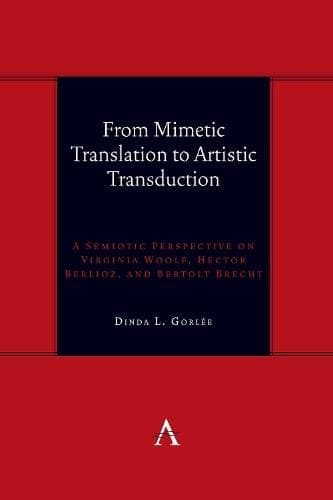
Roman Jakobson gave a literary translation of the double words and concepts of poetical hyper translation. Language can transmit verbal translation to explore new ways of thinking about music and other arts. Thomas A. Sebeok deconstructed the energy of translation into the duplicated genres of artistic transduction. In semiotics, transduction is a technical expression involving music, theater, and other arts. Jakobson used Saussure’s theory to give a single meaning in a different art but with other words and sounds, later followed by Peirce’s dynamic energy with a floating sensation of the double meaning of words and concepts. For semiotician Peirce, literary translation becomes the graphical vision of ellipsis, parabole, and hyperbole. Ellipsis is illustrated by Virginia Woolf’s novel The Waves to give a political transformation of Wagner’s opera Das Rheingold. Parabole is illustrated by the two lines of thought of Hector Berlioz. He neglected his own translation of Virgil’s Aeneid, when he retranslated the vocal text to accompany the musical lyrics of his opera The Trojans. Hyperbole is demonstrated by Bertold Brecht’s auto-translation of Gay’s The Beggar’s Opera. In the cabaret theater of The Three penny Opera, Brecht recreated his epic hyper-translation by retranslating the language of the folk speech of the German working classes with the jargon of criminal slang.Table of Content1.Forked Tongues: Theory from Translation to Transduction; Exploring New Avenues of Translation; Jakobson’s Concept of Poetry in Translation; From Translation to Transduction; Sebeok’s Transduction; 2. Wave after Wave: Wagner’s Waves Eclipsed by Virginia Woolf; Play Within Play; Three Waves; Wagner’s Water Music; Virginia Woolf’s Brain Waves; 3. War and Love: The Parabolic Retranslation in Berlioz’s Opera; Berlioz’s Poetical Drama; Olympic Odyssey; Hunt and Storm; 4. The Threepenny Opera: Jakobson’s Poetics Retranslated in the Spirit of Brecht’s Work-Plays; New Tongues for Brecht’s Language; Brecht Juggling with Gay’s The Beggar’s Opera; From Speech to Criminal Slang; Epic Epilogue; Bibliography; IndexReview Quote“DindaGorlee has been a pioneer of research in intersemiotic translation for more than three decades now. In this work, she delves deeper into the topic through an in-depth analysis of Jakobson’s work on translation, enriched by insights from biosemiotic theory. Her fascinating empirical analyses of opera and drama demonstrate her theoretical insight.” -- Kobus Marais, Department of Linguistics and Language Practice, University of the Free State, South Africa.Review QuoteDindaGorlée is an international renowned scholar who has done an impressive work on understanding what translation really is. Her mastery of European culture makes this new book truly fascinating. -- Jaime Nubiola,University of Navarra, Spain.Review Quote“The semiotical insight of Dinda Gorlée offers a perfect understanding, not only in literary translation, technically re-translated into self-translation or auto-translation, but now exchanged into Peirce’s transduction — an enriching milestone that Peirce offers in the last years of his life as the intellectual adventure of reflecting the three unknown thought processes. This book reflects Gorlée’s intimate look at the transducted art in the drama of politics and aesthetics. It is a rich archive to know the multiple art of transduction.” — Claudio Guerri, University of Buenos Aires, ArgentinaReview Quote“In her new book, Dinda Gorlée brings to fruition her special way of creative theorizing in interpretations of three major literary giants by forging an exciting trajectory on the theme of translation from Jakobson to Peirce and Sebeok, from linguistic translation to nonverbal signification, and from translation as multimodal cultural exchange to transduction as artistic mimesis.” — Horst Ruthrof, Emeritus Professor FAHA FICI, Murdoch University, Perth, Western AustraliaBiographical NoteDinda L. Gorlée works as a general linguist at the Wittgenstein Archives at the University of Bergen.Discusses how literary translation can be retranslated into new ways of thinking about music and other arts in transduction.