No variants available in Vietnam (VND).
Description
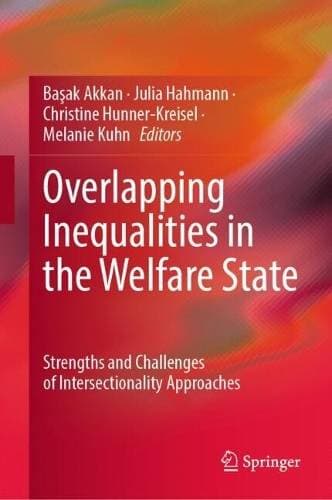
The volume explores the overlapping inequalities within welfare states considering temporal and spatial dimensions. It does so by examining the institutional and organizational frameworks as well as the social practices that underpin the welfare states. Informed by this perspective, the volume provides a critical reflection on the phenomenon of intersectional inequalities highlighting that inequalities do not only overlap but also have the potential to mask each other. The volume, therefore, adopts a critical and process-focused approach to intersectionality. The contributions discuss the extent to which selective inequality factors have emerged in various institutional fields, organizational settings and society in general. They provide insights into the realms of health, education and social services, focus on the relationship between paid and unpaid care work, examine state practices of criminalization, and analyse various forms of activist positions, social movementsand political resistance. The volume demonstrates the potential of intersectional analyses while also reflecting on the methodological challenges and addressing the gaps and limitations of intersectional perspectives. Readers across the social sciences, and particularly those interested in the issues of complex inequalities and welfare, will find this book valuable. Table of ContentPart 1 How to address multiple and overlapping inequalities?.- Methodological and Theoretical Research Approaches.- II. Institutionalized and organizational inequalities in welfare states.- Political considerations, activist positions and social movements.- Paid Labour and Care Work.- Health System.- Educational System.- Social Assistance and Social Service System.- Crime, Policing and the State.Biographical NoteBaşak Akkan, PhD, is a faculty member at Istanbul Bilgi University Department of International Relations. Her research focuses on theories of justice and inequality with a particular emphasis on intersectionality, feminist analysis of care regimes, and child well-being. She is a research partner of CUWB, an international research network devoted to studying child well-being. She serves as an associate editor for the International Journal of Care and Caring. Her scholarly work has been published in various scientific journals, including Child Indicators Research, Children and Youth Services, Feminist Theory, Historical Social Research, Journal of Gender Studies, Social Inclusion, and Social Politics. Julia Hahmann, PhD, is a trained sociologist and works as a Professor for Social Exclusion and Participation at the RheinMain University of Applied Sciences in Wiesbaden, Germany, Faculty of Applied Social Sciences. Her research focuseson single parenthood, alternative family concepts, friendship, caring practices, material and materialist gerontology, feminist and gender theories as well as qualitative methods. She is board member of the German Sociological Association and board member of the working group “Material Gerontology”. Her latest English publication is Friendship Repertoires and Care Arrangement. A Praxeological Approach. International Journal of Aging and Human Development and Material communities: Critical materialisms for the Aging Studies in the Journal of Aging Studies. Christine Hunner-Kreisel, PhD, was Professor for Transculturality and Gender at the University of Vechta (Germany), Social Work, Faculty I of Education and Society Science. Her area of expertise was Childhood and Youth, Child Well-Being, Education, Intersectionality and the analysis of Social Inequalities as well as qualitative methodology. She had expertise in qualitative research in transnational settings as well as with ethnographic research. Christine Hunner-Kreisel was Editor-in-Chief of Child Indicators Research and executive board member of the International Society for Child Indicators. Melanie Kuhn, PhD. is Professor for Educational Science with a main emphasis on education and inequality at the University of Education Heidelberg, Germany. Her main research areas are differences, inequalities and professionalization in the educational system, childhood and migration studies with a specific interest in antigypsyism. She has an expertise in qualitative and especially ethnographic methodologies. The volume analyses overlapping inequalities in European welfare states in time and space by looking at the institutional and organizational frameworks of these states. Informed by this perspective this volume provides a critical reflection on the phenomenon that inequalities not only overlap but mask each other as well. It therefore adopts a critical and process-focused approach to intersectionality. The contributions discuss to what extent selective inequality factors have emerged in various institutional fields, organizational settings and in society in general. They provide insights into the health system, education and the social assistance and social service systems, and focus on the relationship between paid and care work, state practices of criminalization, and political forms of resistance. In showing the potential of intersectional analyses, this volume reflects on the methodological challenges and addresses the gaps and limitations of intersectional perspectives at the same time. It highlights the conceptual relatedness of the intersectional paradigm with political considerations, activist positions and social movements. Readers across the social sciences, and particularly those interested in inequality issues and welfarism, will find this book particularly valuable. Deals with the institutional and organizational processes of welfare states Addresses a variety of the realms of welfare states including health Brings together scholars from different disciplines and diverse geographies