No variants available in Vietnam (VND).
Description
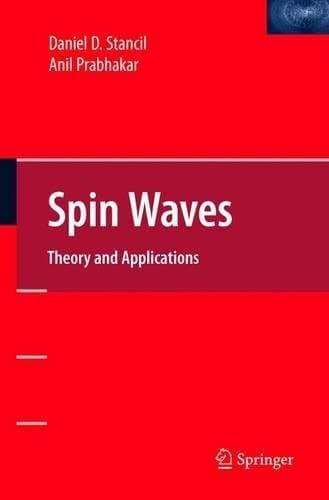
Magnetic materials can support propagating waves of magnetization; since these are oscillations in the magnetostatic properties of the material, they are called magnetostatic waves (sometimes “magnons” or “magnetic polarons”). Under the proper circumstances these waves can exhibit, either dispersive or nondispersive, isotropic or anisotropic propagation, nonreciprocity, frequency-selective nonlinearities, soliton propagation, and chaotic behavior. This rich variety of behavior has led to a number of proposed applications in microwave and optical signal processing. This book begins by introducing magnetism and discusses magnetic properties of materials, magnetic moments of atoms and ions, and the elements important to magnetism. It then goes on to cover magnetic susceptibilities, electromagnetic waves in anisotropic dispersive media, magnetostatic modes, and propagation characteristics and excitation of magnetostatic waves among other topics. There are problems at the end ofeach chapter, many of which serve to expand or explain the material in the text. The bibliographies for each chapter give an entry to the research literature. Spin Waves: Theory and Applications serves not only as an introduction to an active area of research, but also as a reference for workers in the field.Table of Contentto Magnetism.- Quantum Theory of Spin Waves.- Magnetic Susceptibilities.- Electromagnetic Waves in Anisotropic-Dispersive Media.- Magnetostatic Modes.- Propagation Characteristics and Excitation of Dipolar Spin Waves.- Variational Formulation for Magnetostatic Modes.- Optical-Spin Wave Interactions.- Nonlinear Interactions.- Novel Applications.Review QuoteFrom the reviews: "The book is a textbook on spin waves. It comprises 10 chapters (plus some mathematical appendices) which deal respectively with the physics of magnetism in magnetic insulators ... . The mathematical prerequisite is standard, and the book is quite suitable for graduate students." (Guy Jumarie, Zentralblatt MATH, Vol. 1172, 2009) "The present text is ... based on a fully quantum-mechanical treatment, includes extensive discussions of nonlinear interactions and solitonic excitations, and of course incorporates current applications. Within 330 pages, a careful reader has the opportunity to gain an impressive range of knowledge and understanding of spin waves, from the quantum-mechanical origins of macroscopic magnetism ... to the experimental tools to probe their properties and intriguing modern technological applications. ... Each chapter contains several problems and a useful list of references to the original publications."--- (Uwe C. Tauber, Mathematical Reviews, Issue 2010 j)Spin Waves: Theory and Applications covers topics foundational to understanding spin waves such as the physics of magnetism and electromagnetic waves in anisotropic media, as well as both classical and quantum mechanical treatments of spin wave excitations. The authors discuss many applications including microwave delay lines, spin wave-optical devices, and microwave oscillations induced by spin transfer torques in multilayer structures. The material provides explanations and developments of concepts that assist students and researchers interested in beginning work on topics related to magnetic excitations. The book can be divided into three major parts. The first is comprised of Chapters 1-4 and is concerned with the physics of magnetism and electromagnetic waves in magnetic media. The second part, Chapters 5-8, focuses on magnetostatic modes and dipolar spin waves, their properties, how to excite them, and how they interact with light. Finally, Chapters 9and 10 treat nonlinear phenomena and advanced applications of spin wave excitations. Spin Waves: Theory and Applications provides an introduction to an active area of research and a handy reference for workers in the field. The material is useful for graduate students in physics, materials science, or electrical engineering as well as active researchers in fundamental and applied magnetism.Introduces magnetism and discusses magnetic properties of materials, magnetic moments of atoms and ions, and the elements important to magnetism Covers magnetic susceptibilities and electromagnetic waves in anisotropic dispersive media among other topics Contains problems at the end of each chapter, many of which serve to expand or explain the material in the text Includes bibliographies for each chapter that give an entry to the research literature Includes supplementary material: sn.pub/extras