No variants available in Vietnam (VND).
Description
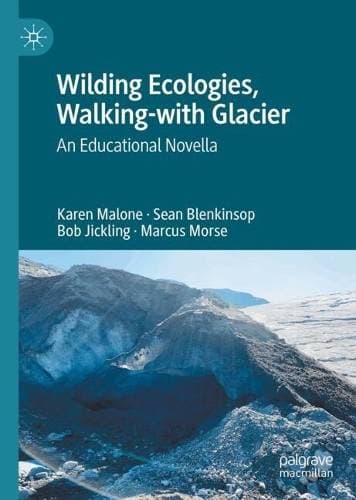
This book is an educational novella composed from diverse encounters of walking-with a glacier, offering the reader possibilities for wilding ecologies as a means to be immersed in more-than-human lives and places. Wild rivulets of ecologies run through this novella, shifting fragments of geologic time over a disintegrating, icy, and watery landscape. Walking-with is positioned in the novella as an embodied methodology for attuning to, slowing down and paying attention. While walking, we weep, and bear witness to the unseen. In turn, this novella works with flows of pedagogy, theory, and collective creative practice. Glacier stories speaking through photographs, prose, poetry, and provocations. Collectively, the gathering of experiences in this book explores what it means to be human and more-than-human in the context of glacial melt and shifting loss. What is means to be changing our planet and, all the time, changing ourselves. Wilding ecologies emerges in the book, as a means to disrupt these anthropocentric ways of knowing, and by showing up, being affected, we can reawaken a newfound love and enchantment. Table of ContentAcknowledgments.- Dedications.- Authors Biographies.- List of Figures.- Walking-with Glacier.- Witnessing-with Glacier.- Weeping-with Glacier.- Awakening-with Arne.- Dreaming-with Glacier.- Appendix.- Index.Biographical NoteKaren Malone is Professor of Education and Environmental Philosophy at Swinburne University of Technology, Australia. She researches Human-Earth relations and applies ecofeminist, posthumanist and Indigenous theoretical perspectives to her studies of the ecological crisis including climate change, militarised radiation and biodiversity loss. Sean Blenkinsop is Professor, Faculty of Education, Simon Fraser University, Vancouver, Canada. He has been involved in starting three nature-based, place-based, eco-schools (all in the public system) and has written extensively about these experiences and the philosophical underpinnings of eco-education writ large. Bob Jickling is Professor Emeritus at Lakehead University, Canada. He has interests in environmental education and ethics, and his current research attempts to find openings for radical re-visioning of education. His most recent book is Environmental Ethics: A Sourcebook for Educators. As a long-time wilderness traveller, much of his inspiration is derived from the landscape of his home in Canada’s Yukon. Marcus Morse is Associate Professor of Outdoor and Environmental Education at the University of Tasmania, Australia. His research focuses on place-based and relational outdoor environmental education, community engagement projects, river experience, and wild pedagogies.This book is an educational novella composed from diverse encounters of walking-with a glacier, offering the reader possibilities for wilding ecologies as a means to be immersed in more-than-human lives and places. Wild rivulets of ecologies run through this novella, shifting fragments of geologic time over a disintegrating, icy, and watery landscape. Walking-with is positioned in the novella as an embodied methodology for attuning to, slowing down and paying attention. While walking, we weep, and bear witness to the unseen. In turn, this novella works with flows of pedagogy, theory, and collective creative practice. Glacier stories speaking through photographs, prose, poetry, and provocations. Collectively, the gathering of experiences in this book explores what it means to be human and more-than-human in the context of glacial melt and shifting loss. What is means to be changing our planet and, all the time, changing ourselves. Wilding ecologies emerges in the book, as a means to disrupt these anthropocentric ways of knowing, and by showing up, being affected, we can reawaken a newfound love and enchantment. Karen Malone is Professor of Education and Environmental Philosophy at Swinburne University of Technology, Australia. Sean Blenkinsop is Professor, Faculty of Education, Simon Fraser University, Vancouver, Canada. Bob Jickling is Professor Emeritus at Lakehead University, Canada. Marcus Morse is Associate Professor of Outdoor and Environmental Education at the University of Tasmania, Australia. “Wilding Ecologies: Walking-with Glacier” is a courageous and honest attempt of the authors to bear witness, to move beyond just thinking and talking about threatened wild places and landscapes. What is needed, they argue, is to live with and listen to those places too, like the Hardangerjøkulen glacier in Norway. The group draws deep inspiration from visiting the elevated hut of the late ecophilosopher Arne Næss, who held that “the smaller we come to feel ourselves compared with the mountain, the nearer we come to participating in its greatness.” —Jan van Boeckel, Professor Art & Sustainability, Hanze University of Applied Sciences, Groningen, The Netherlands “Wilding Ecologies: Walking-with Glacier" is a poetic journey into the heart of our changing planet. The authors eloquent narrative weaves theory and pedagogy seamlessly, urging us to embrace a more interconnected, less anthropocentric worldview. As we walk alongside the melting glacier, the novella invites us to witness the entanglement of lives, human and non-human. Through prose, poetry, and captivating visuals, this book becomes a profound exploration of care and appreciation, a vital call to reawaken love and enchantment for our uncertain future.” (Michael A. Peters, Distinguished Professor, Beijing Normal University, China) “Wilding Ecologies: Walking-with Glacier” is a courageous and honest attempt of the authors to bear witness, to move beyond just thinking and talking about threatened wild places and landscapes. What is needed, they argue, is to live with and listen to those places too, like the Hardangerjøkulen glacier in Norway. The group draws deep inspiration from visiting the elevated hut of the late ecophilosopher Arne Næss, who held that “the smaller we come to feel ourselves compared with the mountain, the nearer we come to participating in its greatness.” (Jan van Boeckel, Professor Art & Sustainability, Hanze University of Applied Sciences, Groningen, The Netherlands) “The wild pedagogues in this novella ask: What will it take to nurture caring, compassionate, and competent restorers of the earth? Can the idea of wild pedagogies provoke opportunities for reimagined relationships and experiences of enlarged human and more-than-human community? Walking with Glacier does not provide any definitive answers to these questions but it helps us slow down and contemplate in a deeply profound way that provides some guidance in where we might go next as a human species.” (Arjen Wals, Professor Transformative Learning for Socio-ecological Sustainability, Wageningen University, The Netherlands) “This book’s wonderful set of detailed-rich stories from wild pedagogues on a trip to the Hardangerjøkulen glacier in Norway is as enjoyable to read, as it is informative and a call to radically transform environmental pedagogies. It is an essential read for any environmental teacher who seeks to transform current (environmental) education and disrupt the Anthropocene saturated in Western ideologies that distance humans from the rest of Nature – the inquiry groundings of Wild Pedagogies.” (Greg Misiaszek, Assistant Professor, Institute of Educational Theories, Beijing Normal University, China) Assembles a response to what it means to care and appreciate more-than-human places as wilding ecologies Explores the rich complexities of attuning to a melting Glacier Calls for a reawakening of love and enchantment for an uncertain future and a changing planet