Description
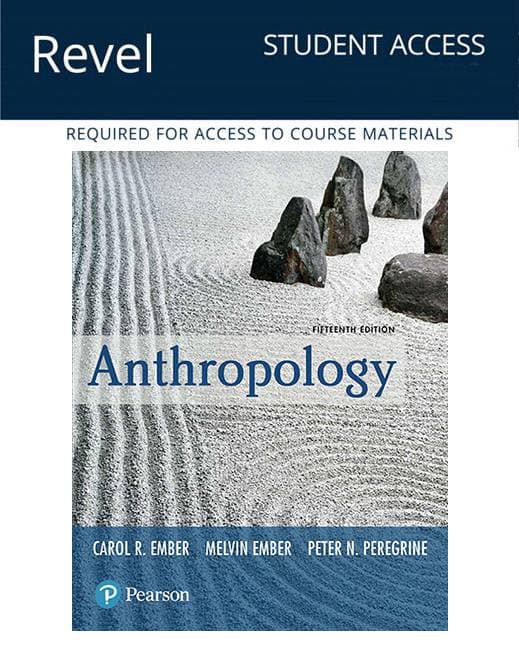
For courses in General Anthropology (Four Fields) A comparative exploration of human cultures across space and time Revel™ Anthropology takes a unique and holistic approach to the study of anthropology with an emphasis on the biological, social and cultural aspects of human life. Transcending mere descriptions, the text explains not only what humans are and were like, but also how they got to be that way, in all their variety. Authors Carol Ember, Melvin Ember, and Peter Peregrine provide comparative, cross-cultural insights based on an evidence-based approach which is highly relevant today. The 15th Edition offers a streamlined narrative that makes it easier for instructors to cover all aspects of the discipline in a single semester, as well as thoroughly updated research that ensures an up-to-date learning experience. Revel™ is Pearson’s newest way of delivering our respected content. Fully digital and highly engaging, Revel replaces the textbook and gives students everything they need for the course. Informed by extensive research on how people read, think, and learn, Revel is an interactive learning environment that enables students to read, practice, and study in one continuous experience — for less than the cost of a traditional textbook. Table of Content1. What Is Anthropology2. Research Methods in Anthropology3. Genetics and Evolution\4. Human Variation and Adaptation5. Primates: Past and Present6. The First Hominins7. The Origins of Culture and the Emergence of Homo8. The Emergence of Homo sapiens9. The Upper Paleolithic World10. Origins of Food Production and Settled Life11. Origins of Cities and States12. Culture and Culture Change13. Culture and the Individual14. Communication and Language15. Getting Food16. Economic Systems17. Social Stratification: Class, Ethnicity, and Racism18. Sex and Gender19. Marriage and the Family20. Marital Residence and Kinship21. Associations and Interest Groups22. Political Life: Social Order and Disorder23. Religion and Magic24. The Arts25. Health and Illness26. Practicing and Applying Anthropology Biographical NoteCarol R. Ember started at Antioch College as a chemistry major. She began taking social science courses because some were required, but she soon found herself intrigued. There were lots of questions without answers, and she became excited about the possibility of a research career in social science. She spent a year in graduate school at Cornell studying sociology before continuing on to Harvard, where she studied anthropology, primarily with John and Beatrice Whiting. For her PhD dissertation, she worked among the Luo of Kenya and studied the possible effects of task assignment on the social behavior of children. For most of her career, she has conducted cross-cultural research on topics such as variation in marriage, family, descent groups, and war and peace, mainly in collaboration with Melvin Ember, whom she married in 1970. All of these cross-cultural studies tested theories on data for worldwide samples of societies. Her recent research funded by the National Science Foundation focuses on possible effects of climate-related hazards on cultural institutions and practices. From 1970 to 1996, she taught at Hunter College of the City University of New York. She has served as president of the Society of Cross-Cultural Research and was one of the directors of the Summer Institutes in Comparative Anthropological Research, which were funded by the National Science Foundation. She has recently served as President of the Society for Anthropological Sciences. Since 1996, she has been at the Human Relations Area Files, Inc., a nonprofit research agency at Yale University, first serving as Executive Director and since 2010 as President of that organization. Melvin Ember majored in anthropology at Columbia College and went to Yale University for his PhD. His mentor at Yale was George Peter Murdock, an anthropologist who was instrumental in promoting cross-cultural research and building a full-text database on the cultures of the world to facilitate cross-cultural hypothesis testing. This database came to be known as the Human Relations Area Files (HRAF) because it was originally sponsored by the Institute of Human Relations at Yale. Growing in annual installments and now distributed in electronic format, the HRAF database currently covers more than 385 cultures, past and present, all over the world. Melvin Ember did fieldwork for his dissertation in American Samoa, where he conducted a comparison of three villages to study the effects of commercialization on political life. In addition, he did research on descent groups and how they changed with the increase of buying and selling. His cross-cultural studies focused originally on variation in marital residence and descent groups. He has also done cross-cultural research on the relationship between economic and political development, the origin and extension of the incest taboo, the causes of polygyny, and how archaeological correlates of social customs can help us draw inferences about the past. After four years of research at the National Institute of Mental Health, he taught at Antioch College and then Hunter College of the City University of New York. He served as president of the Society for Cross-Cultural Research. From 1987 until his death in September, 2009, he was president of the Human Relations Area Files, Inc., a nonprofit research agency at Yale University. Peter N. Peregrine came to anthropology after completing an undergraduate degree in English. He found anthropology’s social scientific approach to understanding humans more appealing than the humanistic approach he had learned as an English major. He undertook an ethnohistorical study of the relationship between Jesuit missionaries and Native American peoples for his master’s degree and realized that he needed to study archaeology to understand the cultural interactions experienced by Native Americans before their contact with the Jesuits. While working on his PhD at Purdue University, he did research on the prehistoric Mississippian cultures of the eastern United States. He found that interactions between groups were common and had been shaping Native American cultures for centuries. Native Americans approached contact with the Jesuits simply as another in a long string of intercultural exchanges. He also found that relatively little research had been done on Native American interactions and decided that comparative research was a good place to begin examining the topic. In 1990, he participated in the Summer Institute in Comparative Anthropological Research, where he met Carol R. Ember and Melvin Ember. He is professor of anthropology at Lawrence University in Appleton, Wisconsin, and external professor at the Santa Fe Institute in Santa Fe, New Mexico. He also serves as research associate for the Human Relations Area Files. He continues to do archaeological research and to teach anthropology and archaeology to undergraduate students. Dynamic content designed for the way today's students read, think, and learn Integrated within the narrative, theory and concepts are brought to life through interactives and videos created to empower students to engage with concepts, and take an active role in learning. Revel's media interactives have been designed to be completed quickly, and videos are brief, so students stay focused and on task. Revel's quizzing, integrated throughout as well as at the end of each module, provides students opportunities to check their understanding at regular intervals before moving on. Revel's writing functionality, available in select courses, enables educators to integrate writing—among the best ways to foster and assess critical thinking—into the course without significantly impacting their grading burden. Self-paced Journaling Prompts throughout the narrative encourage students to express their thoughts without breaking stride in their reading. Assignable Shared Writing Activities direct students to share written responses with classmates, fostering peer discussion. Highlighting, note taking, and a glossary let students customise their reading and studying experience. Instructors can add notes for students too, including reminders or study tips.New and updated content keeps the text current UPDATED! The authors offer a streamlined narrative in order to make it easier for instructors to cover all aspects of anthropology in a single semester. The dedicated chapter covering global problems in previous edition has been eliminated, with key global problems content integrated throughout the remaining content. Because global issues are introduced in context, students will be able to better understand the anthropological approach to these problems. The part structure has been eliminated to grant instructors more flexibility in developing their syllabi. The authors worked with a professional photographer and the Lawrence University Department of Anthropology to obtain high-quality photographs to accurately illustrate the text discussion. Key new images depict the following:Key aspects of dentition in Chapter 5;Skulls of various early hominins in Chapter 6; and Skulls of Homo habilis/rudolfensis and Homo erectus/ergasterin Chapter 7. UPDATED! The 15th Edition has been updated with current research citations to ensure that students are receiving the latest information. Highlights include the following:New information on Homo naledi, the most recently identified member of the Homo genus in Chapter 7; More detailed information from recent DNA studies to the discussion of human origins in Chapters 7, 8, and 9; A discussion of agriculture as a form of niche construction in Chapter 10; Coverage of issues such as whether language promotes sexist thinking in Chapter 14; New information on environmental and climate change in Chapters 15, 16, and 26; and Updated and new content on global inequality in Chapter 17. Boxed features highlight key iss